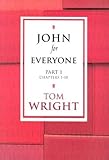
 The gospel of John is covered in two volumes of Tom Wright’s “For Everyone” series. The basically format is that he provides his own translation of the text (say 10-20 verses) followed by a page or two of expositional and devotional thoughts. These usually begin with a brief anecdote or illustration, and go on to expound the meaning of the passage in question. The format lends itself particularly to being used in daily devotions.
Wright is well known in theological circles for his work on both the gospels, and on Paul, bringing his own unique perspective to many passages, while remaining in the evangelical tradition. As I mentioned recently, many in reformed circles are unsure whether to take him as a friend or a foe. However, at the very least his historical expertise is able to shed much light onto many passages, even if not all his theological conclusions are agreed with.
The gospel of John actually provides less opportunity for controversy, as Wright’s preterist approach to many of the parables and eschatological teaching of the Synoptics does not occur, and the “exile” theme is not so prominent. In fact, I was reading this at the same time as reading Don Carson’s commentary on John, and noticed many places where the two are in close agreement with their interpretation and application of key passages.
Wright uses his historical knowledge to bring many passages to life, and he emphasises Jesus as the alternative to the Temple early on. In the first book, he encourages us to see that John is listing seven signs that point to who Jesus is. In some places, he notes where the authenticity of some of Jesus’ sayings have been doubted, but encourages us to believe, giving brief reasons why they should not be doubted on historical terms. He particularly sees echoes of the Old Testament exodus and passover stories in much of John’s material. There was also a very interesting link with the story of David’s three warriors getting water for him in the “drinking blood” part of John 6.
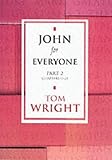 The second volume on John covers chapters 11-21 and does not presuppose that you have read the first volume. In the discussion on the true vine in chapter 15, Wright emphasises Jesus as the true Israel. The chapter also includes criticism of historical wars in the name of Christianity.
As well as the exodus theme, Wright sees links with the Genesis creation story in more than just the prologue, such as seeing Gethsemane the new garden of Eden where the true Adam is sent to his death by the false ones.
In the trial scene, Wright does not attempt to provide a harmonisation of the order of events with the synoptics, but does seek to defend the gospel’s portrayal of Pilate. Pilate’s two motivations of avoiding trouble and snubbing the Jews reveal his actions as historically plausible. Unlike many schemes, Wright sees the cross itself as the seventh sign in John (walking on the water is not counted).
As he deals with Jesus’ death and resurrection Wright’s focus is more devotional. We are encouraged to stand in awe and wonder at the event, and called to appreciate Easter rather than Christmas as the high point of the Christian calendar. He sees chapter 21 as a later addition but still talks as though he accepts Johannine authorship of it.
Despite his interest in historical matters, these certainly do not dominate the discussion, and Wright consistently looks for ways to apply the text. Sometimes this is in the form of a challenging question intended for further reflection, while in other places he spells out some of the practical implications. As with so many others in the “For Everyone” series, I can recommend these two volumes on John as a very helpful study guide. They will broaden your understanding of the theology, historical background, and ongoing challenge of the gospel of John.
3 comments