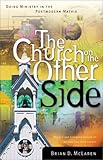
 The thesis of this book is pretty straightforward: the times are changing, and the church had better move with the times. We are transitioning from modernism to postmodernism and the church on “the other side” of this great cultural shift will look very different to the modern church. McLaren therefore offers us twelve strategies to help us successfully navigate the change and build churches that are appropriate and relevant for the new world. “A new world needs a new church.”
McLaren clearly believes there is something very wrong with the current state of the church - “human beings are incurably religious, yet Christianity has lost its power to satisfy us”. His solution is not renewal or reformation (indeed he is critical of these approaches). No the church must be “re-invented”. He claims that there are no “blueprints”. Most evangelicals will be wondering what place he gives to the Bible as the foundation for our ecclesiology. They will still be wondering by the end, and left suspecting that the answer is “almost none”.
Many of the typical emerging church concerns are outlined. The church needs to be more honest about its failures, less dogmatic, less arrogant, less caught up with traditions (and more connected to “Tradition”), less about personal salvation and more about community now. We should focus on what unites us rather than our doctrinal distinctives and embrace all types of Christian spirituality. A nuanced Amen to most of that.
He talks about the need for a new apologetic. “Proofs” of the Christianity to make it more credible are no longer needed for a postmodern world. Rather, Christianity must be seen to be plausible by being a community people would want to join.
McLaren is very hard to pin down on doctrine (probably deliberately). His approach seems to be the politicians favourite “I can neither confirm nor deny that doctrine…”. For example, he speaks of the need to stop fighting against other religions and fight alongside them, leaving you not quite sure of his position on the exclusiveness of Jesus for salvation.
The church needs to find a new rhetoric, which is to say it needs to talk less and do more. He calls for churches to become a lot less attached to their structures, and to reject the models of leadership found in modern evangelicalism such the “Bible answer man” who will fix any doubt with a quick proof-text, or the “successful” mega-church pastor who promises you perpetual victory and prosperity.
He lists many reasons why traditional “missions” are running out of steam, and suggests new models where we think more holistically about “mission”.
The book finally closes with three chapters on postmodernism. He is convinced that it is the future, and that we should not only understand it, but embrace it. He sees it as the future not only in western culture but worldwide.
It is not hard to see why Brian McLaren is so popular. He certainly identifies a number of real problems in the church, and suggests many good ideas for improvement. However, this book left me feeling uneasy for a number of reasons.
First, while I do not claim to be in any way an expert on culture, it seems remarkably simplistic to subsume everyone under one new umbrella of “postmodernism”. I see a world containing many diverse cultures, and though “modernists” may indeed be dying out, they certainly still exist and need to be reached with the gospel.
Second, after identifying many ways in which the church has unfortunately embraced the negatives of modernism, it seems bizarre that he should be so eager for the church to reconfigure itself to be exactly what post-moderns are asking for. He somewhat cheekily suggests that he need not critique postmodernism because (grumpy old) D A Carson has already done enough of that!
Third, while making clear that he does not accept relativism, it is almost entirely unclear what he believes the basis for knowledge is. He wants to encourage creative and “messy” thinkers, to re-invent the church, to embrace new paradigms. But how will he judge these ideas? It certainly does not seem like he would offer the Bible as any kind of objective standard.
Maybe McLaren would say that this question reveals that I am stuck in a “modernist” mindset. And perhaps it does. But when one of his messy thinkers suggests that all religions lead to God, or that we should all dance round naked at the church worship service, on what basis will he accept or reject their proposals? Is the church on the other side able to detect heresy? Or is the only heresy the idea that heresy is even possible?
I would only recommend this book to those interested in understanding the emerging church’s ecclesiology. The good ideas he proposes can also be found in books by those far more rooted in Scripture. Jesus has already “invented” the church. We do not need to re-invent it, but maybe we do need to re-discover his original intentions for it, and re-configure the way we speak and act so that we are truly able to communicate the unchanging truth of the gospel to a post-modern world.
4 comments