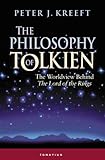
 As someone who has not read The Lord of the Rings in its entirety (I got about a third of the way through), and who doesn’t have a particular passion for fiction or philosophy, this book might not seem the most obvious of choices for me. But a blog review I read a while ago piqued my interest, I put it on my Amazon wishlist, and lo and behold, it arrived as a Christmas present.
Fortunately, despite its title, this book does not require you to have a deep knowledge of everything Lord of the Rings and Tolkien. Simply having seen the movies will be enough for you to follow along for the most part. However, Kreeft clearly loves the the book and makes the assumption that his readers share his passion. More than that, Kreeft is in full agreement with Tolkien’s Christian (and distinctively Catholic) worldview.
The way the book is structured is to answer about 50 key philosophical questions. For the most part these are nicely phrased in layman’s terms: “Does God exist?”, “Are we both fated and free?”, “Is knowledge always good?”, “Do principles or consequences make an act good.”
As well as covering the most obvious philosophical questions, there are some surprises. “Are angels real?”, “Do things have personalities?”, “How can words be alive?”.
Each question is discussed with a look in the Lord of the Rings for any clues to Tolkien’s worldview as well as some quotes from C S Lewis that state a similar perspective directly. So in many ways, this book is much about the worldview of Lewis as it is of Tolkien.
Whilst the one or two pages devoted to each answer can only scratch the surface of the topic, there is certainly plenty of food for thought. What made Lewis in particular so refreshing (and Tolkien seems to have shared this characteristic), was a kind of old-fashionedness to his point of view - he wasn’t afraid to question whether the “progress” of modern thinking was indeed progress in the right direction.
Despite focusing on the writings of Tolkien and Lewis, Kreeft also has a good way with words and brings some of his own ideas to the table. In a section on the power of music, he claims that “music is the original language. … Poetry is fallen music, and prose is fallen poetry”.
Overall I would say that despite losing me in a few places (especially when talking about ‘Faerie’), this was a very interesting angle to approach these philosophical questions from. Kreeft also succeeds in demonstrating how, whilst at first glance The Lord of the Rings is absent of any reference to God, Christ or even religion, Tolkien’s Christian worldview shines through very clearly.
2 comments